Iran Called for 1 Million Military Volunteers. Over 11 Million Reportedly Signed Up.
State media and independent monitors report a staggering response to Tehran's mobilization call — a number Western analysts are scrambling to verify and contextualize.
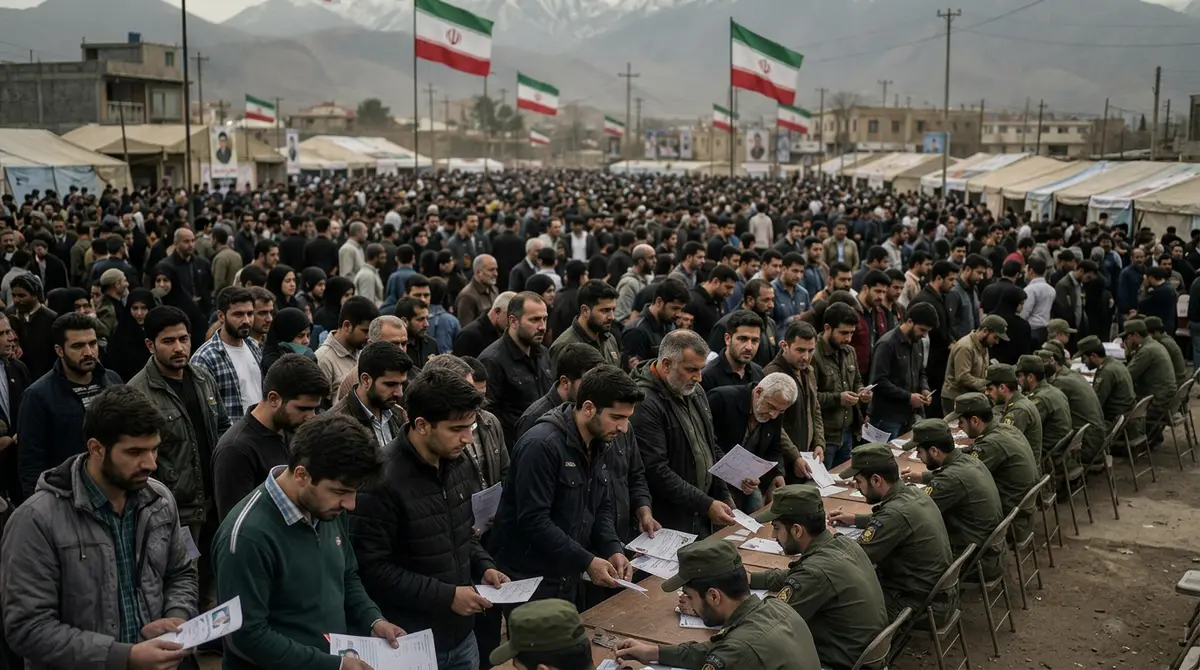
Iran's military leadership called for 1 million civilian volunteers to register for reserve service this month. According to state broadcaster IRIB, more than 11 million people responded.
If accurate, the figure would represent the largest single mobilization drive in Iranian history.
Basij issues the recruitment order
The original appeal, issued by the Basij Resistance Force under the IRGC, asked for volunteers aged 18–55 to register at provincial recruitment centers. Officials cited the need to prepare for "any future aggression" following this year's strikes on Iranian nuclear sites.
Queues form across five major cities
State media released drone footage showing kilometer-long queues in Tehran, Mashhad, Isfahan, Tabriz, and Shiraz. Independent monitors at BBC Persian and the Atlantic Council's DFRLab confirmed the crowds shown were real and large — though they cautioned the 11 million figure cannot be independently verified.
Why the 11 million figure deserves scrutiny
Western analysts interviewed by Foreign Policy offered three caveats:
- Registration is not deployment. Many sign-ups are symbolic.
- Social pressure in Basij-organized neighborhoods inflates participation.
- The regime needs the optics of mass loyalty after a difficult year.
But even discounting heavily, the underlying signal is real: Iranian nationalism is surging, even among populations hostile to the regime on domestic issues.
A reserve army that raises the cost of invasion
Iran's standing armed forces number roughly 610,000. Adding millions of trained reservists would not change Iran's ability to project force abroad — but it would dramatically raise the cost of any ground invasion of Iranian territory.
The message to Washington and Tel Aviv
For Tehran, the recruitment drive is as much a message to Washington and Tel Aviv as it is a logistics exercise. The clerical leadership wants to demonstrate that strikes on its territory unify, rather than fracture, the country.
Sources: IRIB · BBC Persian · Atlantic Council DFRLab · Foreign Policy · Reuters