Inside China's Vertical Farming Push: More Crops, Less Water, Zero Soil
Beijing is pouring billions into indoor agriculture as climate stress and a shrinking rural workforce threaten food security for 1.4 billion people.
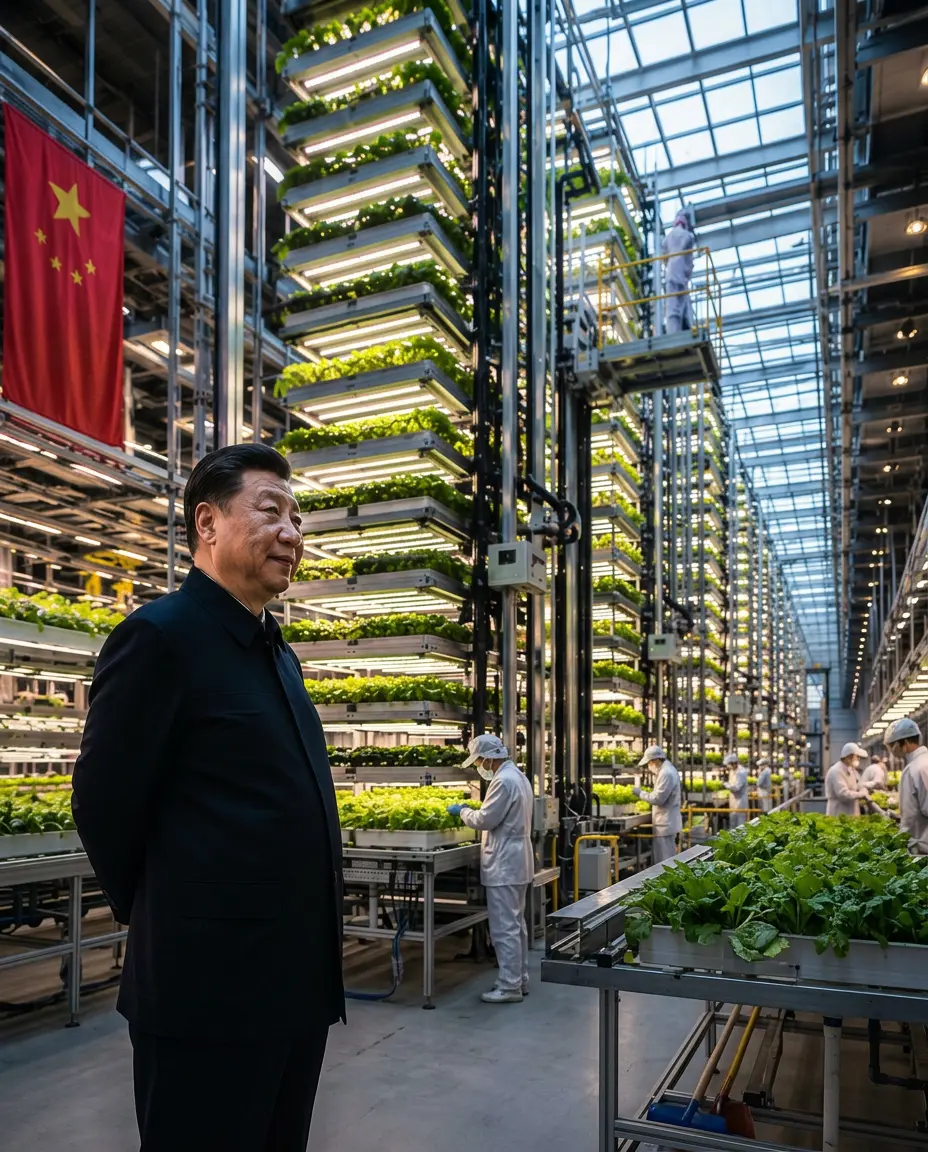
China is rapidly becoming the world's largest builder of vertical farms — multi-story indoor facilities that grow leafy greens, strawberries and herbs year-round under LED lights, with a fraction of the land and water of conventional agriculture.
The scale of the push
According to the Chinese Academy of Agricultural Sciences, more than 250 commercial vertical farms now operate across the country, with state-backed mega-facilities planned in Shandong, Sichuan and Guangdong. A single 20-story plant outside Chengdu can produce up to 10 metric tons of lettuce per day.
"Vertical farming is no longer an experiment. It is part of our national food strategy." — Yang Qichang, lead researcher, Chinese Academy of Agricultural Sciences
Why now
- Climate pressure. Heatwaves and floods cost Chinese farmers an estimated $8 billion in 2024 alone, according to the Ministry of Agriculture.
- Shrinking workforce. The rural population has fallen by more than 200 million since 2000.
- Water scarcity. Northern China is depleting aquifers faster than they can recharge. Vertical farms use up to 95 percent less water than open-field equivalents.
The technology
A modern Chinese vertical farm combines hydroponics, AI-driven climate control, and tunable LED spectra. Sensors monitor every tray; algorithms adjust nutrients in real time. Some facilities are fully robotic from seedling to harvest.
The catch
Energy is the Achilles heel. LED lighting and HVAC make these farms electricity-hungry — a problem partly offset by China's aggressive solar buildout, but still a concern in coal-heavy provinces. Economically, only high-value crops currently pencil out; staple grains remain the domain of traditional fields.
What it means globally
Chinese firms are already exporting turnkey vertical-farm systems to the Gulf, Singapore and parts of Africa. If domestic costs continue to fall, the model could reshape how water-stressed regions feed themselves.
Sources: Xinhua, Nikkei Asia, Chinese Academy of Agricultural Sciences, FAO.