The 1960 'Doomsday Equation' That Predicted Humanity Ends in November 2026
A forgotten paper published in Science magazine 66 years ago calculated humanity's extinction date down to the week — and the deadline is now months away.
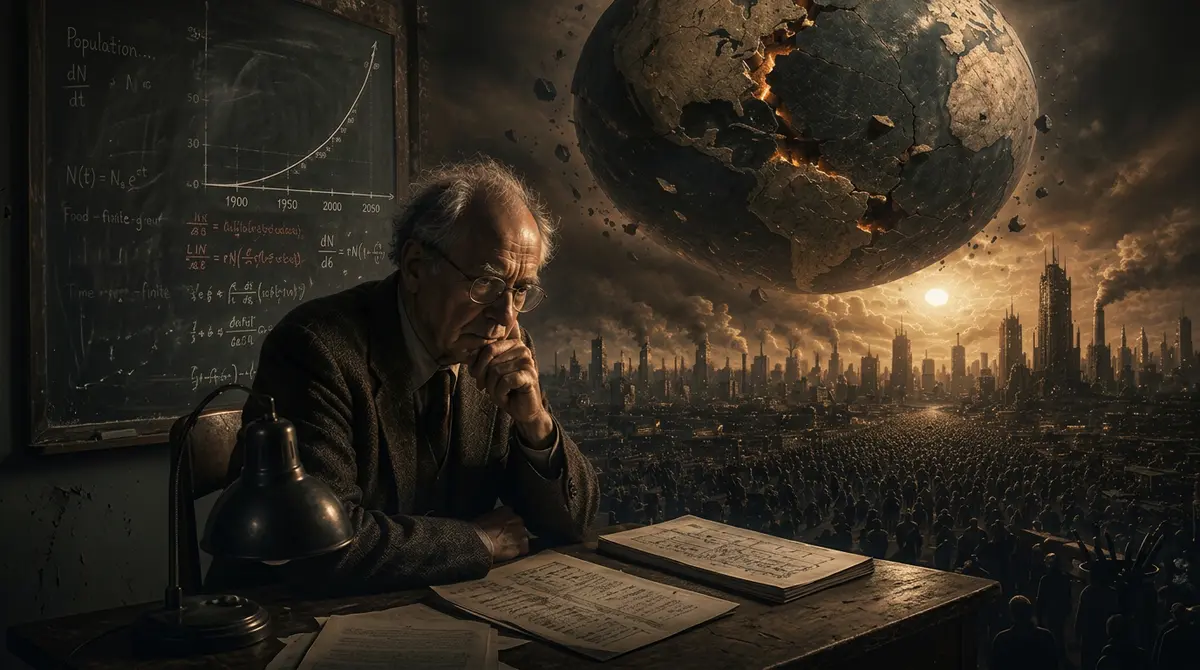
In 1960, three scientists — Heinz von Foerster, Patricia Mora, and Lawrence Amiot — published a paper in Science with a title that read like satire: "Doomsday: Friday, 13 November, A.D. 2026."
It wasn't satire. It was math.
The Equation
The team fit centuries of human population data to a hyperbolic growth curve. Their model — now nicknamed the von Foerster Doomsday Equation — projected that population would reach infinity on a single calculable date:
Friday, November 13, 2026.
The point, von Foerster argued, wasn't that humans would literally become infinite. It was that the existing growth trend was mathematically impossible to sustain and would have to break — through famine, war, disease, or collapse — before the deadline.
Why It Mattered
The paper was widely mocked at first. But within a decade:
- 1968: Paul Ehrlich publishes The Population Bomb.
- 1972: The Club of Rome releases The Limits to Growth.
- 1970s–80s: Global fertility rates begin a historic decline.
The hyperbolic curve broke, just as von Foerster predicted — though through demographics, not catastrophe.
So What About November 13, 2026?
Today's population sits near 8.1 billion, growing at the slowest rate in modern history. Demographers expect a peak around 10.4 billion in the 2080s — followed by decline.
The original equation is no longer predictive. But its central insight — that exponential trends always bend or break — has aged remarkably well, and is now being applied to AI compute, energy demand, and climate forcing.
The Takeaway
We almost certainly won't end on November 13, 2026. But we will, almost certainly, look back on this decade as the one where several exponential curves finally hit their walls.
Sources: Science (Vol. 132, 1960), United Nations DESA, Our World in Data, MIT Technology Review.